


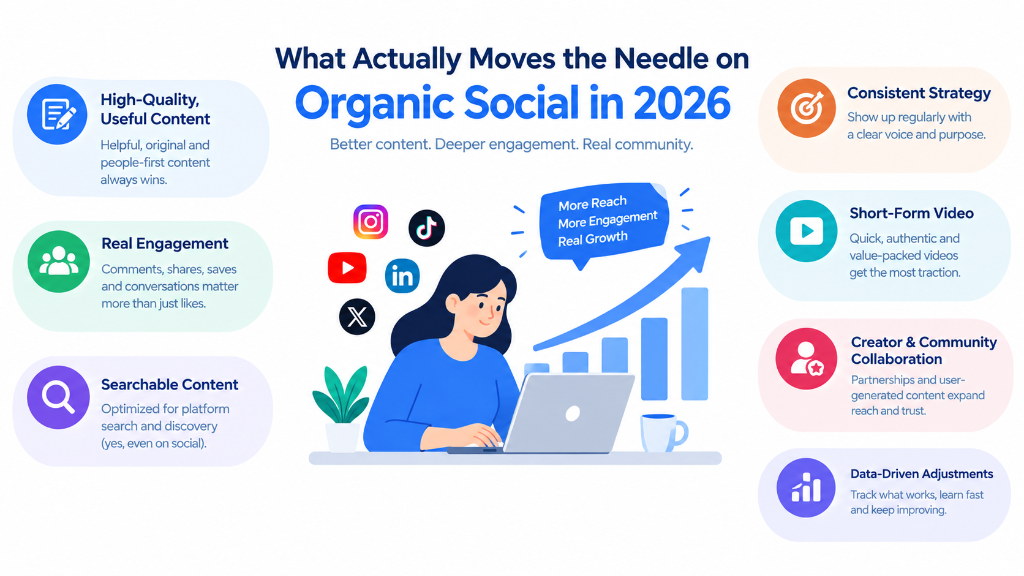

Organic social media is the process of using social platforms to build awareness, relationships, and ongoing engagement without paying for every individual impression or interaction. It includes the content a business publishes, the conversations it joins, and the community it develops around its brand.
Organic social media is different from paid advertising. Paid campaigns can be useful when a business needs controlled distribution for a specific offer or audience, while organic content focuses more on building a consistent presence and creating reasons for people to follow, engage with, and return to a brand.
What Organic Social Media Is Actually For
Organic social media can support several different business goals. These may include educating an audience, communicating a company's perspective, answering common questions, showcasing products or services, supporting existing customers, and building relationships with a community.
Not every post needs to generate a direct sale. A useful organic strategy starts by deciding what role social media should play within the broader marketing strategy.
Before publishing, ask:
- Who is this content intended to help?
- What does the audience need to understand?
- What action should the audience take, if any?
- How does this post support the broader business objective?
Organic Social Media vs Paid Social Media
| Area | Organic Social | Paid Social |
|---|---|---|
| Distribution | Primarily uses the platform's organic distribution and existing audience. | Uses advertising spend to distribute content to selected audiences. |
| Main focus | Relationships, content, engagement, and ongoing presence. | Controlled reach, campaigns, offers, and targeted promotion. |
| Content | Posts, videos, conversations, educational content, and community interactions. | Sponsored posts, advertisements, promoted content, and campaign creatives. |
| Measurement | Engagement, audience growth, content interaction, and other relevant outcomes. | Campaign-specific metrics such as impressions, clicks, conversions, and cost. |
The two approaches do not have to be treated as competing strategies. A business can use organic content to develop its presence while using paid campaigns when paid distribution is appropriate.
Choose Platforms Based on the Audience
A common mistake is trying to maintain an active presence on every social platform.
Instead, identify where the intended audience actually spends time and what type of content works naturally on that platform.
Consider:
- Where the target audience is active.
- What type of content the platform supports.
- Whether the business can consistently produce suitable content.
- What role the platform should play.
- Whether the team can realistically manage conversations and responses.
A smaller number of well-managed platforms can be easier to maintain than a large number of neglected profiles.
Define a Clear Audience
Content becomes easier to plan when the audience is specific.
Instead of targeting "everyone interested in technology," define the audience in terms of relevant needs, roles, problems, or interests.
For example, a technology company might create content for business owners evaluating software, developers looking for technical guidance, or marketing teams trying to improve their digital processes. Each group may need a different type of content.
Build Content Around Useful Themes
Content pillars are recurring themes that help organize social publishing.
A business might use themes such as:
- Educational guidance.
- Product or service information.
- Industry insights.
- Behind-the-scenes content.
- Customer questions.
- Company culture and people.
The exact pillars should reflect the business and audience. Their purpose is to make content planning more consistent without forcing every post into the same format.
Start With Audience Questions
Useful social content often begins with questions the audience is already asking.
Review customer conversations, support questions, sales discussions, website content, search queries, and comments to identify recurring topics.
Then turn those topics into content that answers a specific question rather than creating posts simply because a publishing schedule says something must be posted.
Create Platform-Appropriate Content
The same idea can be adapted for different platforms, but copying the exact same post everywhere may not produce the best experience.
Each platform has its own audience expectations, content formats, and interaction patterns.
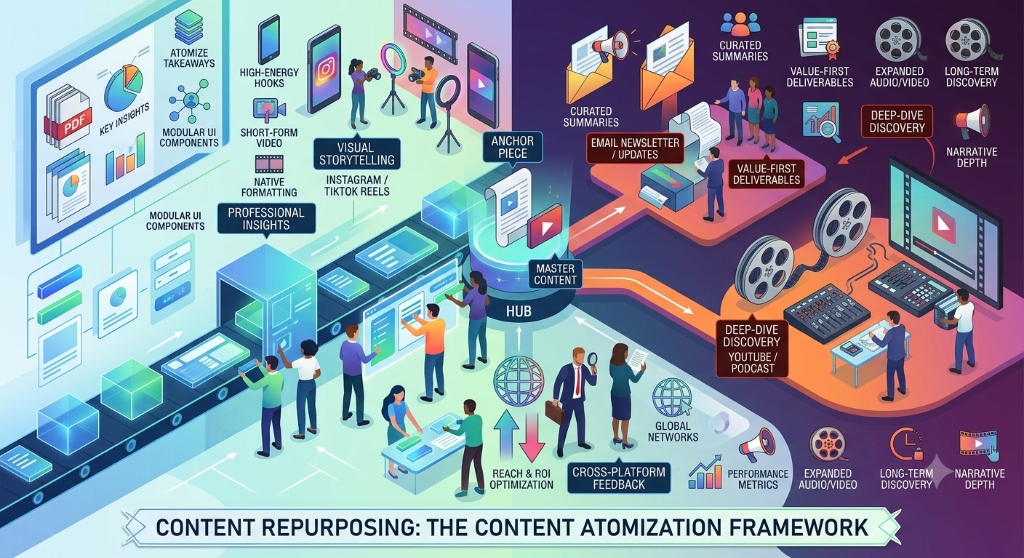
For example, one idea could become:
- A detailed professional explanation on LinkedIn.
- A visual summary on Instagram.
- A short educational video.
- A concise discussion prompt on X.
- An expanded explanation in an email newsletter.
The underlying idea can remain consistent while the presentation changes according to the platform.
Use a Repeatable Content Workflow
A simple workflow can make organic social media easier to manage.
- Identify an audience problem or useful topic.
- Research the subject and verify important claims.
- Choose the most appropriate platform.
- Select a suitable content format.
- Create the first draft.
- Review the content for accuracy and clarity.
- Publish it at an appropriate time for the audience.
- Monitor relevant responses and conversations.
- Record useful performance observations.
- Use those observations to improve future content.
The workflow should be simple enough that the team can follow it consistently.
Focus on Value Before Promotion
An organic social feed that only promotes products or services can become difficult for an audience to engage with.
Promotional content has a place, but useful educational or informative content can give people a reason to follow the account even when they are not ready to buy.
A useful question before publishing is: "Would this post still be useful to the intended audience if they never purchased from us?"
Make Engagement Part of the Strategy
Organic social media is not only about publishing posts. It also involves participating in conversations.
Monitor relevant comments, questions, and mentions. Respond where a response can provide value, clarification, or customer support.
When a recurring question appears repeatedly, consider turning it into a future piece of content. This creates a connection between community interaction and content planning.
Do Not Treat Every Comment as a Marketing Opportunity
Community interaction should feel natural and relevant.
Respond directly to the question or concern rather than turning every conversation into a sales message. When someone needs detailed support, move the conversation to the appropriate support channel where necessary.
This distinction helps keep social channels useful for both the audience and the business.
Measure Meaningful Results
Follower count alone does not explain whether an organic social strategy is working.
Choose measurements that connect to the objective of the content.
| Objective | Potential Signals to Monitor |
|---|---|
| Awareness | Reach, impressions, profile visits, and relevant audience growth. |
| Engagement | Comments, shares, saves, replies, and meaningful interactions. |
| Traffic | Visits to relevant website pages from social channels. |
| Leads | Qualified enquiries or other defined lead actions. |
| Community | Quality of conversations, recurring participation, and useful feedback. |
The appropriate measurement depends on the purpose of the content. A post designed to educate may not have the same success criteria as a post designed to generate enquiries.
Review Content Quality, Not Just Numbers
Quantitative metrics should be combined with qualitative observations.
A post may receive many interactions but provide little useful information about why people engaged. Comments and messages can reveal whether the content actually answered a question or generated meaningful discussion.
Review both the numbers and the nature of the response.
Use Analytics to Improve Future Content
Regular review can help identify patterns in the content that performs well for the intended objective.
Look for patterns such as:
- Topics that consistently generate useful discussions.
- Formats that are easy for the audience to consume.
- Questions that repeatedly appear in comments.
- Content that generates relevant website traffic.
- Posts that attract attention but do not support the intended objective.
Use these observations to guide future experiments rather than assuming that one successful post will always produce the same result.
Maintain a Practical Content Calendar
A content calendar can reduce last-minute publishing decisions.
It can contain:
- Publishing date.
- Platform.
- Content topic.
- Content pillar.
- Format.
- Primary objective.
- Draft status.
- Review status.
- Published URL where applicable.
The calendar should support the workflow rather than becoming an administrative task that takes more effort than content creation.
Repurpose Strong Ideas Carefully
A useful idea does not always need to be created from scratch for every platform.
One strong topic can be adapted into different formats, provided each version is appropriate for its audience and platform.
For example, a detailed article can provide material for a short video, a visual explanation, a social discussion, or an email. The goal is to adapt the idea, not repeatedly publish identical content.
Use AI as an Assistant, Not a Replacement for Review
AI tools can help with brainstorming, outlining, summarizing, or adapting content. However, generated content still needs human review.
Before publishing AI-assisted content, verify factual claims, remove unsupported statements, check whether the content actually helps the intended audience, and ensure that the final version reflects the business's actual expertise and perspective.
Common Organic Social Media Mistakes
- Trying to publish on every available platform.
- Posting without a clearly defined audience.
- Creating content only to fill a calendar.
- Making every post promotional.
- Copying identical content across platforms without adaptation.
- Ignoring comments and community conversations.
- Measuring success only through follower count.
- Chasing engagement without considering business objectives.
- Publishing unsupported or unverified information.
- Using AI-generated content without meaningful human review.
A Practical Organic Social Media Checklist
- Define the audience you want to reach.
- Define what social media should accomplish for the business.
- Select platforms based on audience and content fit.
- Define several useful content themes.
- Research real audience questions and problems.
- Create platform-appropriate content.
- Review important factual claims before publishing.
- Maintain a realistic publishing calendar.
- Monitor comments and relevant conversations.
- Measure results against the purpose of each post.
- Review both quantitative and qualitative feedback.
- Reuse successful ideas through appropriate formats.
- Review and improve the strategy regularly.