


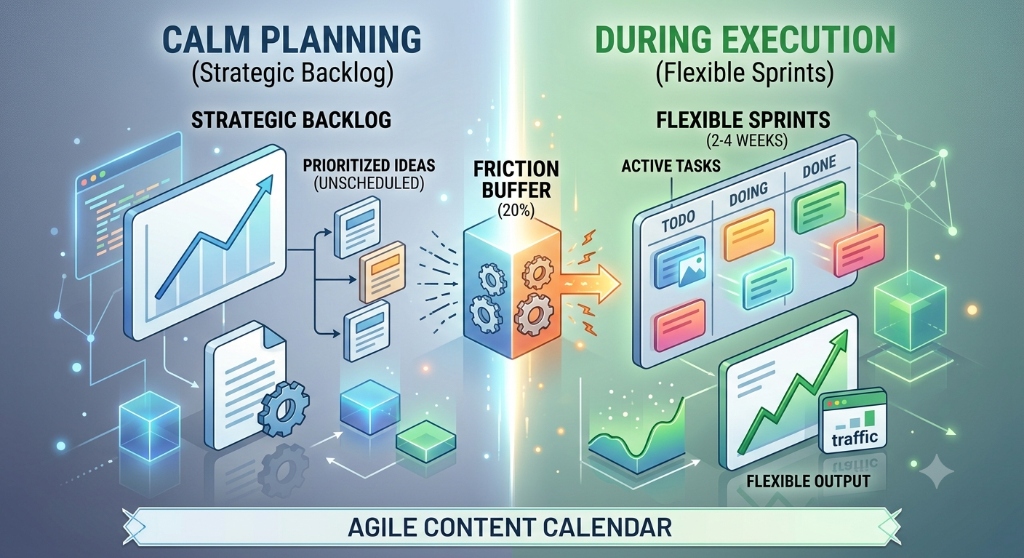

A content calendar is useful only when a team can continue using it after priorities change. A plan that looks organized at the beginning of a quarter can become difficult to maintain when launches move, approvals take longer, new business priorities appear, or the team has less time than expected.
The goal of a durable content calendar is therefore not to predict every post months in advance. It is to create enough structure for consistent publishing while leaving enough flexibility to respond to real business needs.
Start With a Content Strategy, Not a List of Dates
A calendar should translate a content strategy into an actionable publishing plan. If the strategy is unclear, adding more rows, colors, labels, and deadlines will not solve the underlying problem.
Before creating individual content entries, define the main purpose of the content. Depending on the business, that purpose might include educating an audience, answering common questions, supporting product discovery, demonstrating expertise, explaining services, or maintaining communication with an existing audience.
Each planned topic should have a reason for existing. A simple planning question is:
- Who is this content for?
- What problem or question does it address?
- What should the reader understand after consuming it?
- How does it relate to the broader content strategy?
- What action, if any, should the reader be able to take next?
This creates a stronger foundation than starting with dates alone.
Use Themes for Long-Term Planning
Long-term content planning becomes easier when the calendar uses themes instead of trying to define every individual post several months ahead.
A quarterly or monthly theme can describe the subject area, campaign, audience problem, or business priority that content should support. Individual articles, social posts, videos, emails, and other formats can then be selected closer to publication.
| Planning level | What to define | How much flexibility to keep |
|---|---|---|
| Quarterly | Major themes, campaigns, business priorities | High |
| Monthly | Topic groups, important events, content goals | Medium |
| Weekly | Specific topics, formats, owners, deadlines | Lower |
| Daily | Execution, review, publishing, engagement | Based on current priorities |
This structure separates strategic planning from detailed execution. A change in one topic does not require rebuilding the entire calendar.
Plan Detailed Content Only as Far Ahead as You Can Execute
One common planning problem is creating a detailed calendar too far into the future. A team may know that a subject will be important next quarter without knowing the exact format, title, message, or publishing date that will make sense several weeks from now.
A better approach is to keep the long-term plan broad and make the near-term plan specific.
For example, a content team could maintain:
- A quarterly list of major themes.
- A monthly view of campaigns and important business events.
- A detailed two- or three-week execution plan.
- A small collection of flexible content ideas that can be developed when needed.
The exact planning window should depend on the team's workflow. The important principle is that detailed planning should remain close enough to execution that the information used to create the content is still relevant.
Build a Content Bank
A content calendar becomes fragile when every publishing slot depends on a completely new piece of work being created immediately before publication.
A content bank provides another option. It can contain evergreen topics, partially developed ideas, reusable research, approved visual assets, frequently asked questions, or completed pieces that do not depend on a particular date.
The content bank should not simply become a storage location for unfinished ideas. Each item should have enough information to determine what it is and what work remains.
| Content-bank field | Purpose |
|---|---|
| Topic | Identifies the subject |
| Audience | Identifies who the content is intended for |
| Format | Article, email, social post, video, guide, or another format |
| Status | Idea, research, draft, review, approved, or ready |
| Owner | Identifies the person responsible for the next step |
| Timeliness | Shows whether the content is evergreen or date-sensitive |
This makes the bank useful during busy periods instead of turning it into another backlog that nobody reviews.
Put the Business Calendar Beside the Content Calendar
Content does not operate separately from the rest of a business.
Product launches, seasonal campaigns, sales activity, events, hiring campaigns, major announcements, planned downtime, and other important dates can affect what should be published and when it should be published.
Keeping these activities visible alongside the content plan helps the team identify conflicts before production work is completed.
For every important business event, ask:
- Does the content need to support this event?
- Does the event change the audience's likely questions?
- Does another campaign already occupy the same publishing period?
- Are additional approvals required?
- Will the team actually have enough time to produce the planned content?
Give Every Content Item a Clear Owner
A calendar becomes difficult to maintain when responsibility is shared by everyone but owned by nobody.
Every important content item should have a clear owner for the next stage of work. The owner does not necessarily need to perform every task. Their responsibility is to make sure the item continues moving through the workflow.
A simple workflow might look like:
- Idea identified.
- Topic reviewed.
- Brief created.
- Draft produced.
- Content reviewed.
- Changes completed.
- Final approval given.
- Content published.
- Performance reviewed.
Different teams can combine or expand these stages, but the responsibility for moving each item forward should remain clear.
Keep Approval Rules Simple
Multiple stakeholders can make a content calendar difficult to manage when every person can add, change, or publish content without a shared process.
Define who can request content, who reviews it, who gives final approval, and who is responsible for publishing. These roles can be different people, but the workflow should be visible to everyone involved.
A simple approval structure can prevent several common problems:
- Duplicate topics being scheduled at the same time.
- Conflicting campaigns competing for attention.
- Content being published before required review.
- Last-minute requests replacing higher-priority work without discussion.
- Old calendar entries remaining active after business priorities change.
Leave Room for Unplanned Content
A useful content calendar should not assume that every valuable piece of content can be predicted in advance.
Industry developments, customer questions, product updates, company announcements, and emerging conversations can create legitimate reasons to adjust the plan.
The answer is not to abandon the calendar whenever something new appears. Instead, create an explicit process for deciding whether an unplanned item deserves space in the schedule.
Before replacing planned content, ask:
- Is the new topic genuinely time-sensitive?
- Does it serve the intended audience?
- Does it support an important business objective?
- What existing content would be delayed?
- Does the new content require additional approval?
This turns reactive publishing into a deliberate decision rather than a disruption to the entire workflow.
Use Content Statuses That Reflect Real Work
Too many calendar statuses can make a workflow harder to understand. Too few can hide important bottlenecks.
A practical set of statuses could include:
| Status | Meaning |
|---|---|
| Idea | The topic exists but has not been planned |
| Planned | The topic has been selected for a publishing window |
| In Progress | Someone is actively working on it |
| Review | The draft is waiting for feedback or approval |
| Ready | The content is approved and prepared for publishing |
| Published | The content has been released |
| Revisit | The item needs changes before it can continue |
The exact labels matter less than making the workflow understandable to everyone who uses the calendar.
Measure Whether the Calendar Supports Execution
A content calendar should be evaluated by more than the number of posts scheduled.
Useful operational questions include:
- How many planned items were completed?
- How many were delayed?
- Where did work commonly get blocked?
- How often were deadlines changed?
- How much content was added after the planning period?
- Which types of content repeatedly required more time than expected?
- Are important business priorities represented in the calendar?
These measurements help distinguish a content problem from a process problem. If content is repeatedly delayed at the approval stage, for example, adding more topics to the calendar will not solve the bottleneck.
Review the Calendar Regularly
A content calendar should be maintained like an operational system rather than treated as a document that is created once and forgotten.
A regular review can answer four important questions:
- What is still relevant?
- What should be removed or postponed?
- What new priorities need to be added?
- Where is the current workflow creating unnecessary work?
The review frequency can depend on the team's publishing volume. A fast-moving team may need frequent short reviews, while a smaller team may use a weekly execution review and a monthly strategic review.
Repurpose Content Without Repeating It
A strong content calendar can also connect related pieces of content instead of treating every publication as a completely separate project.
For example, a detailed article can provide the source material for a newsletter, a short educational post, a discussion prompt, or a presentation topic.
Repurposing should not mean copying the same message everywhere without adapting it. Each format should have a clear purpose and should be appropriate for the audience using that channel.
A simple repurposing workflow is:
- Choose a useful source piece.
- Identify its strongest ideas.
- Choose formats that fit those ideas.
- Adapt the message to each format.
- Review each version independently before publishing.
Common Content Calendar Mistakes
Planning Every Post Too Far Ahead
Long-range detail creates unnecessary rework when priorities change.
Confusing Activity With Strategy
A calendar full of publishing dates does not automatically mean the content serves a clear purpose.
Having No Content Buffer
When every item depends on new work being completed immediately, one delay can affect the entire schedule.
Allowing Unlimited Last-Minute Changes
Flexibility is useful, but constant changes make planning meaningless. Define a process for urgent requests.
Giving Ownership to a Group Instead of a Person
Teams can collaborate, but each item still needs clear responsibility.
Ignoring Business Priorities
Content planned separately from product, sales, operations, and campaign calendars can quickly become disconnected from the business.
Measuring Only Publishing Frequency
Publishing more content does not automatically mean the content process is working. Review quality, relevance, execution problems, and audience response as appropriate.
A Practical Content Calendar Checklist
- Define the primary purpose of the content strategy.
- Identify the main audience for each content theme.
- Group long-term planning into broad themes.
- Keep detailed planning closer to execution.
- Maintain a useful content bank.
- Mark evergreen and time-sensitive content clearly.
- Connect the content calendar with important business dates.
- Assign a clear owner to every active content item.
- Define the approval workflow.
- Use simple and understandable content statuses.
- Leave room for legitimate unplanned opportunities.
- Record why major schedule changes were made.
- Review delayed and repeatedly blocked content.
- Remove outdated topics instead of keeping them indefinitely.
- Review the calendar regularly.
- Measure whether the planning process is helping the team execute.